
Have you noticed that your child’s teeth are coming in crooked? Early orthodontic problems can be easy to spot in some children but more difficult to see in others. Do you know how to tell if you need braces? What age do kids get braces?
Zombek Orthodontics sees patients of all ages in Hollywood, FL, and Weston, FL. Dr. Zombek knows that the sooner you treat orthodontic issues, the better they can be treated.
Recognizing the signs that your child may need braces or Invisalign is essential. However, your child should see an orthodontist, even if they don’t need braces.
Identifying the signs that you need braces is crucial for children and adults. Recognizing these signs early can help prevent more serious dental issues.
Some common indicators that you may need braces include crooked teeth, crowded teeth, and gaps between teeth. You might also notice misaligned bites, such as overbites, underbites, or crossbites.
If you’ve ever wondered, “What are the signs that I need braces?” you’re not alone.
If you notice these signs in your or your child’s teeth, visiting an orthodontist is a good idea. An orthodontist can provide a professional evaluation and recommend the best treatment plan. Braces for your child or adult braces for yourself might be the best solution to achieve a healthy, straight smile.

The American Association of Orthodontists recommends your child consult with an orthodontist by age 7. All baby teeth are in by this age, and a few permanent teeth should have erupted. On average, a child loses their first tooth at age 6.
Your child may already be showing signs of teeth that need braces. Some signs can appear even before the baby's teeth erupt. What are the signs that you or your child need braces? Here are a few indicators:
Not all symptoms will be visible to you. That’s why consulting with an orthodontist at age 7 is so important. Finding and treating these signs of how to tell if you need braces early can prevent your child from having worse dental problems later.
Just because your child sees an orthodontist early doesn’t mean they’ll get braces early. Some children may not need braces until all adult teeth have erupted.
Other children may need expanders, space maintainers, and other simple orthodontic appliances that may be beneficial at an earlier age. Children may benefit from two-phase braces treatment that addresses major dental issues early and corrects other ones later.
How old do you have to be to get braces? If your child needs braces, we’ll likely put them on around ages 11-13. By then, most of their permanent teeth will be in, and we can move them into their proper places.
We can treat your child with our LightForce braces or with Invisalign Teen. Both options can correct many common dental issues, including:
If your child has serious orthodontic issues, two-phase treatment may be the best option.

Phase 1 braces treatment usually involves orthodontic appliances to correct problems with your child’s teeth and jaws.
A narrow upper jaw can cause teeth crowding. A palate expander widens the jaw, allowing more room for the teeth to come in straight. It also reduces the need for jaw surgery or tooth extraction later to make room for the teeth.
Thumbsucking and overuse of a pacifier can lead to an overbite or open bite. Both habits should end by age 2. If not, we have orthodontic appliances that can stop your child from sucking a thumb or pacifier, which will prevent further damage to your child’s teeth and jaws.
Tongue thrust can also cause dental problems, from creating an open bite to causing speech issues. A tongue crib trains your child’s tongue to rest against the roof of the mouth and away from the back of the upper teeth, reducing the chances of an overbite or open bite.
These and other Phase 1 braces treatments can keep your child from having major dental issues later. Phase 1 treatment usually lasts 6-12 months and can start soon after your child’s first consultation, between ages 7 and 9.
Early orthodontic care can sometimes eliminate the need for braces later. However, Phase 2 treatment is usually necessary.
Phase II treatment happens a few years after Phase I, when most permanent teeth are in. This is when we place braces or Invisalign on your child’s teeth.
Without Phase I treatment, Phase II would likely last much longer. Instead, patients have shorter treatment times because underlying dental issues have been dealt with in Phase I.
On average, your child can expect to wear braces for about 12-24 months or less, but the times can vary depending on the severity of your child’s dental condition. The groundwork we lay in Phase 1 means we don’t have to deal with speech impediments, problems breathing and swallowing, and continuing bad habits we might have without Phase 1 treatment.

How much do children’s braces cost? That depends on the type and severity of the dental problems. Two-phase braces treatment can save money in the long run by making dental issues less severe.
During your first visit with Zombek Orthodontics, we will discuss the costs and review your financing options, such as zero-interest, in-house financing, and low-down payments. We want you to be able to afford your treatment because we believe everyone deserves a beautiful smile!
Is your child right for a two-phase braces treatment plan? Would a few months in Invisalign clear aligners be better? Or does your child need braces at all? The best way to answer these questions is with an orthodontic consultation.
If you’re in the Hollywood, FL, or Weston, FL, areas, schedule an appointment with Zombek Orthodontics when your child turns seven years old. We will thoroughly examine your child and determine which treatment — if any — is best for them.
At Zombek Orthodontics, we aim to give your child the best smile possible that will last a lifetime!

You need your teeth cleaned, but you’re also thinking of getting Invisalign treatment for your teeth. You have a choice between dentist vs. orthodontist. Can you go to just one for both treatments? What’s the difference between a dentist and an orthodontist?
The orthodontist vs. dentist question may seem like a no-brainer. They seem to have the same training. Are orthodontists dentists? Technically, yes, but they’ve had specialized training that a general dentist hasn’t, and that’s the big difference.
Take Dr. Zombek at Zombek Orthodontics in Weston, FL. He trained for years to be a dentist, so technically, he’s a dentist. But he also continued his education with specialized training to become an orthodontist.
That extra training and certification are what prepared him to give you the best options available when it comes to braces and Invisalign treatment. His knowledge and training in repairing bad bites are what mark the difference between a dentist and orthodontist.
People are sometimes confused about the differences between an orthodontist and a dentist. Are all dentists orthodontists? Are all orthodontists dentists? The confusion lies in the fact that dentists and orthodontists start with the same training—to be dentists.
A dentist trains in general dentistry at a dental school. Once they graduate, they are ready to work in general dentistry. They are trained to do everything you expect dentists to do: clean teeth, fill cavities, provide fluoride treatments, and install crowns, among other things. They can work with other dentists or open their own practice.
What they can’t do is treat patients with braces or clear aligners. They need extra training for that.
An orthodontist starts the same way as a dentist by training in dental school. Unlike the dentist, the orthodontist’s training doesn’t end with dental school.
Orthodontists must continue their education in a special certification program. This is where they learn the special field of orthodontics, which includes moving teeth with precision to create beautiful smiles and correct bad bites. Once they receive their certifications, they are officially orthodontists.
Look at it this way: All cardiologists are doctors, but not all doctors are cardiologists. If you have heart problems, you’ll want to go to a cardiologist, not a general practice doctor. It’s the same with dentists and orthodontists. If you want to keep your teeth clean and your mouth healthy, you want to visit a dentist. If you want to straighten your teeth, you need to see an orthodontist.

Now that you know the difference between a dentist and an orthodontist, when do you visit which one? If you want your teeth cleaned, visit your dentist. What if you have a cavity? Dentist!
What does an orthodontist do? They take care of you if you need braces or clear aligners. As an orthodontist, Dr. Zombek can treat you with braces or Invisalign clear aligners. He can treat adults, and he can treat children with these services.
What can orthodontists do besides braces and Invisalign? They can place dental appliances that help correct the structure of your mouth, such as a palate expander, or that correct bad habits, such as a tongue crib to stop tongue thrust or thumb sucking.
Does this mean you won’t need to see your dentist while getting orthodontic treatment? Not at all! In fact, you need to be diligent with your semi-annual cleanings to ensure you don’t get cavities during treatment.
Your dentist will take care of the cavities if you get any, but we hope you will brush and floss regularly to prevent this from happening. Once your braces are off, your dentist will thoroughly clean your teeth so you can see how gorgeous your new smile is!
There are other types of dentistry that require additional education. Some specialties can be performed by a general dentist, such as cosmetic dentistry or restorative dentistry. Others, such as endodontics, require a different type of specialist.
Cosmetic dentistry and restorative dentistry are similar. Both aim to improve the look of your teeth. A cosmetic dentist can improve the look of your teeth through special treatments like adding veneers or crowns, tooth whitening, and color tooth matching.
Restorative dentistry repairs damaged teeth, such as those that are discolored, cracked, broken, or even missing. A restorative dentist can apply crowns or bridges, add dental implants, repair small chips with resin fillers, and help protect teeth with fluoride treatments.
Many dentists have training in cosmetic and restorative dentistry. However, some dentists can specialize in either or both of these fields.
An endodontist is a specialized dentist who deals with the pulp of the tooth and performs more intense treatments to save teeth, including root canals, dental implants, and bone grafting to improve the strength of the jaw around the teeth.
These fields can work in conjunction with your orthodontist to improve the look of your teeth before and after braces. Some patients may need special treatments before braces, such as a root canal or bone graft. Others may want cosmetic treatment after braces, such as teeth whitening.
Some orthodontists, like Dr. Zombek, can perform surgical orthodontics to improve jaw and tooth alignment and make your braces treatment an even bigger success.
Surgical orthodontics can reduce severe gaps in teeth and improve jaw alignment, which can reduce excessive tooth wear, headaches, and jaw pain. Braces treatment can correct teeth placement afterward.
Has your dentist recommended you see an orthodontist? If you live in the Weston, FL, or the Hollywood, FL, areas, we invite you to visit us and see what we can do for you!
Zombek Orthodontics can get you started with our virtual consult tool, which lets you tell us about your case from the comfort of your own home through a computer or mobile device. Then, we’ll bring you in for a thorough evaluation and let you know the best treatment for you. You’ll love your new smile from your orthodontist!
People often get braces to improve the look of their smile, but other things can affect your teeth and gums. Smoking and vaping don’t just affect your lungs. They can also affect your oral health.
Zombek Orthodontics wants you to have the best smile possible. That may include breaking bad habits that can damage your smile, including smoking and vaping. How do they affect teeth and gums? The answers may surprise you.
Braces today can do wonders with a smile in need of dental repairs. However, part of the success depends on patients doing their part to keep good oral hygiene habits and eliminate any bad habits that could damage their teeth.
We encourage our patients to brush their teeth at least twice a day for two minutes at a time. We also encourage patients to floss with dental floss at least once daily.
We also ask our patients to break any habits that might cause damage to the teeth, gums, or braces. This includes smoking and vaping, both of which can damage your teeth as well as your braces or clear aligners. In fact, all types of tobacco products should be avoided during treatment time.
We know smoking can discolor your teeth, but does vaping make your teeth yellow? Yes, it does, because vaping smoke also contains chemicals and acids that can stain your teeth.
Can smoking stain your braces and clear aligners? Can you vape with Invisalign? Despite being stain-resistant, your clear braces or Invisalign can become yellow from the smoke and chemicals.

Both cigarette smoke and vaping smoke contain a host of chemicals, some of which are acidic to your teeth. These chemicals can build up on your teeth around your braces brackets and under your braces wires, making them harder to remove. That’s just the start of the damage smoking and vaping with braces can do.
Braces make it more difficult to remove plaque because of the brackets and wires you must get around. Smoke adds acids and chemicals to the dental plaque that builds up on your teeth and gum tissue.
The buildup of these acids forms a potent plaque that can eat through your tooth’s enamel — the hard, protective outer layer of your tooth. That tooth decay can lead to decalcification of your teeth and eventually lead to cavities.
That same acid and plaque buildup can harm your gums, too. The chemicals can irritate your gums and lead to gingivitis, the first level of periodontal disease. Your gums may become red and swollen and start to bleed. Without intervention, this can lead to infections and tooth loss.
Just as these chemicals can stain your braces or Invisalign, they can also stain your teeth. This is especially bad if you have braces because the smoke likely won’t penetrate under the bonding agent holding your braces brackets to your teeth. The result is lighter squares on your teeth once your braces are removed.
These white spots can be difficult to correct because they will lighten along with the rest of your tooth with any whitening treatment. It will take several precise whitening treatments to improve the look of your teeth from smoking with braces.
Braces and clear aligners work by applying gentle pressure to the teeth down to the root. The pressure causes the bone around the root to break down, allowing the tooth to move. The bone then rebuilds itself behind the tooth, keeping it from getting too loose.
Studies have shown that smoking and vaping break down bone faster than normal, which could affect the braces treatment process. The chemicals also reduce the speed at which the bone rebuilds. It can make it more difficult to control the movement of your teeth during and after braces treatment.
Smoking and vaping can also cause a complication called root resorption. Instead of the root moving normally with the tooth, the body begins breaking down the root and resorbing it back into the body. Without the root, the tooth can die and fall out. This complication is possible with non-smokers, but it happens more often with smokers.
Smoking can also cause bad breath and increase the number and severity of mouth ulcers. These mouth ulcers, sometimes called canker sores, may be slower to heal with smokers because smoking suppresses your immune system.
You should let us or a dental professional know right away if you have an ulcer that hasn’t healed after more than a week, receding gums, swollen or bleeding gums, or other indications of infection.

It is never easy to stop smoking or vaping. Some people move to vaping to try to break a smoking habit, thinking it’s a “step down,” a healthier habit, or easier to stop than cigarettes. The truth is that vaping is just as unhealthy as smoking.
We encourage you to explore your options to stop smoking. There are many techniques available, including prescriptions you can obtain from your doctor, as well as natural remedies and even relaxation techniques. Your primary care physician may be able to recommend the best method for you.
The best way to have successful orthodontic care is to break any bad habits that could damage your teeth during and after treatment, including smoking or vaping. Removing these habits will improve your oral and overall health.
If you’re ready to explore your options, schedule an appointment with Zombek Orthodontics in Weston, FL, or Hollywood, FL. We can draw out a treatment plan that includes time to break your smoking or vaping habit. We’re ready to help you get the smile you’ve always wanted!

Whiter teeth are good, but white spots on teeth aren’t. Some patients find white spots on some teeth after braces. Those spots are called decalcification, and they are preventable.
White marks on teeth with braces usually form around the brackets, but they can occur anywhere on the tooth with or without braces. Good oral hygiene habits are the best way to avoid these white spots.
Zombek Orthodontics wants you to have a successful treatment with a beautiful smile at the end. The best way to ensure this is by brushing and flossing daily and thoroughly throughout your treatment to avoid white spot lesions from forming.
Are white spots on teeth from braces? The answer is no; they aren’t from the braces themselves. However, braces may contribute to why people have white spots on their teeth after braces. That’s because braces can make brushing and flossing your teeth more difficult.
The white spots are called decalcification. It’s the demineralization of calcium in your tooth’s enamel. This causes a thinning of the enamel. Eventually, the thin spots could fall victim to tooth decay and become cavities.
Dental decalcification occurs when bacteria and plaque pull minerals from the enamel. The easiest way to fight this is to brush your teeth regularly and properly. That’s easy to do with nothing on your teeth, but it may be a bit harder with brackets and wires in the way. However, there are tools that make it easier to clean your teeth well.

Teeth decalcification affects the enamel, the hard outer shell of your tooth responsible for protecting the living interior. One of the main components of enamel is calcium. This mineral is targeted by bacteria and acids that make up plaque.
The bacteria and acids leech calcium from the enamel, causing that area of the enamel to thin and turn white. Tooth decalcification is often seen on the front teeth but can also appear on the back teeth.
Certain foods can leave acids and bacteria on your teeth and accelerate the formation of braces white spots. Sugary or acidic foods do this more than others. This includes sodas, citrus fruits, candy, fruit juices, and some sports drinks.
White spots can also form because of certain medical conditions, including chronic dry mouth, poor nutrition, and hypoplasia (enamel thinning). Some of these conditions may be the result of side effects from certain medications. You can speak with your doctor about alternate medications. You can also talk with your dentists about ways to combat chronic dry mouth.
Poor oral hygiene is the main cause of dental decalcification. To avoid white spots, you need to brush your teeth at least twice a day for two minutes and floss at least once a day. Good oral hygiene must be practiced with or without braces.
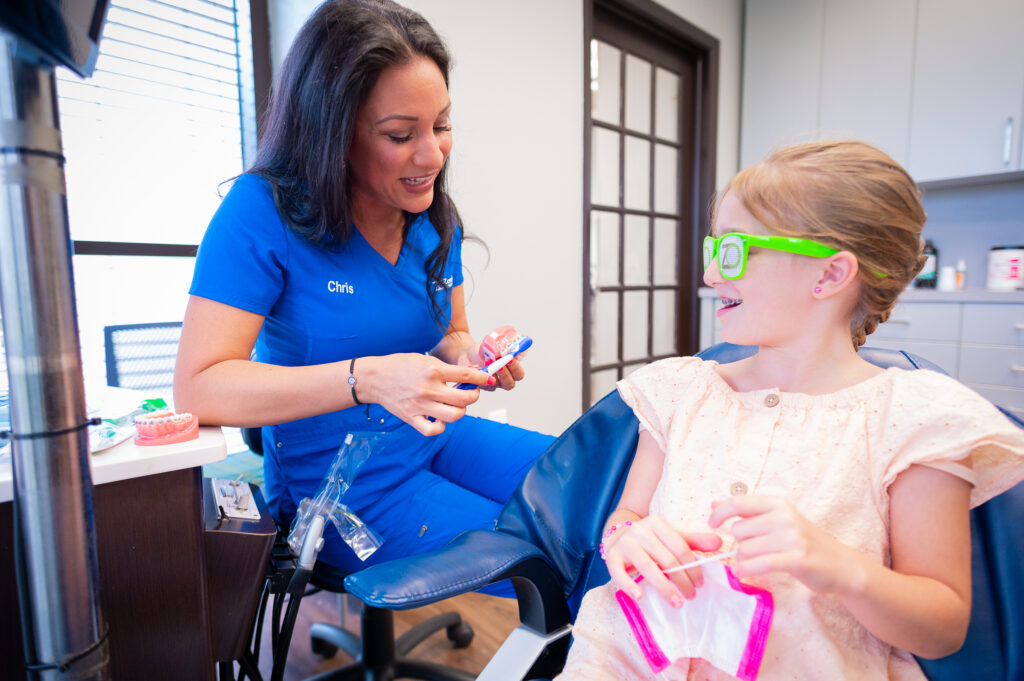
It isn’t always easy to brush and floss with braces, but it’s necessary to prevent white marks on teeth after braces. Here are some top tips to prevent enamel decalcification and poor dental hygiene.
What do you do if you do have white spots after braces? Unfortunately, decalcification on teeth is permanent. There are ways to reduce the appearance of white spots and strengthen your enamel.
Tooth whitening can lighten the tooth color and make the white spots less noticeable. It’s best to have this done professionally to get the best results. However, tooth whitening isn’t permanent. You will need to return for treatments in the future.
You can also treat white spots with microabrasion, which removes a thin layer of enamel to even out the color of your tooth. This can lead to tooth sensitivity, so discussing this option with your dentist is best. You can also discuss dental veneers, thin shells placed on the front of the teeth to give them a flawless appearance.
A fluoride treatment can strengthen your enamel and reduce the chances of developing white spots. Check with your dentist to see if they provide fluoride treatments.
At Zombek Orthodontics, we aim to give you the smile of your dreams. We will do all we can to encourage you on your journey while providing top-notch orthodontic treatment. However, successful braces treatment also depends on you.
The last thing we want to see is white spots on your teeth after braces. The best way to avoid this while wearing braces is to brush and floss your teeth every day. Brushing twice a day and flossing once a day will keep damaging plaque and acid buildup off your teeth. This will prevent decalcification and help you achieve your best smile.
 This site’s strategy, design, photo & video were created by the marginally-above-average folks @ Clear Partnering Group.