
You've made it through your first year in braces. At first, you could see the changes being made. Your canines are no longer above your other teeth. Your bottom teeth are no longer sideways. But after a year in braces, it seems as if things have slowed down.
Can you speed up your braces treatment? Is anything still happening, even though it doesn't seem like it?
Your orthodontist will tell you that consistency is more important than speed. That's because braces treatment is a precise science. Each tooth must be moved a certain way at a certain time so they all fall into place.
Applying too much pressure and moving your teeth too quickly can damage your teeth and jaws. That's why slow, gentle pressure is the key to orthodontic treatment, whether it's with braces or Invisalign.
Zombek Orthodontics creates a plan customized to your teeth and jaws. We know what to move and at what speed to give you the best smile possible. It may seem like things aren't moving after a while, but trust us, they are.
Your teeth move because of two natural processes in your bones: resorption and remodeling.
Gentle pressure applied to the bone causes it to break down and resorb itself. This allows the tooth to move into the space left by the breakdown. The cells that activate this process are called osteoclasts.
Remodeling is when the bone rebuilds itself behind the tooth as it moves. This process uses osteoblasts to rebuild the bone.
Without these two processes, we would not be able to correct your smile. For a deeper look at the biology behind why orthodontic treatment takes time and why some teeth move faster than others, our full breakdown on treatment timelines covers it in detail.
Moving your teeth too quickly would prevent your bones from remodeling as they move. It could also cause the tooth's root to resorb. This would cause the teeth to become too loose and risk falling out. It could also damage your jaw.
This is why we can't move the teeth too fast. It's also why progress with braces may seem slow after a while, even though treatment is still happening.
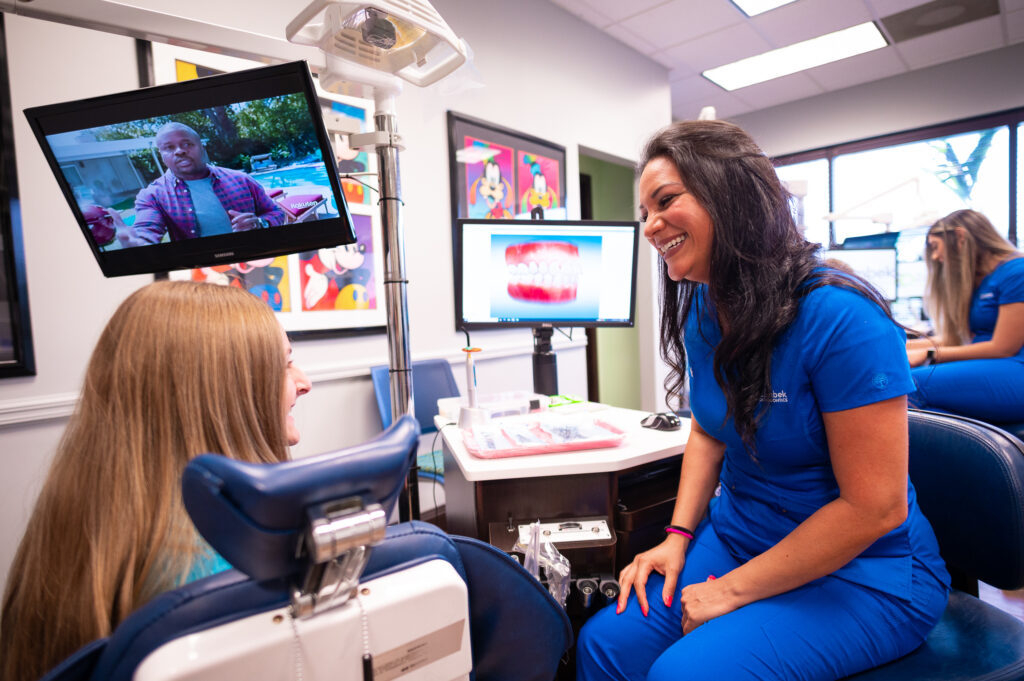
There are two phases of orthodontic treatment with braces or Invisalign. The first phase in the first 12 months produces the most obvious changes. Crowded teeth move apart, gapped teeth move together, impacted teeth move up or down to sit in line with the rest of the teeth. Basically, the teeth are lining up to move into their final positions.
The second phase is less obvious. This is when all of the teeth move into their proper dental arches. Overbites and underbites disappear. Crossbites in the back are resolved. Your teeth make their final journey into their proper places.
Consistency is vital in the second phase because this is when the teeth need to move into the correct position so we can remove your braces on time.
Braces patients need to wear their rubber bands as prescribed so that your jaws can be aligned properly. Invisalign patients need to wear their trays for that full 20-22 hours a day. When you wear aligners consistently and follow your prescribed plan, you give your teeth the best chance of finishing on schedule and with the best possible result.
You may not see the difference in this last phase, but you may start to feel the difference.
You may find it easier to bite and chew. You may bite your cheek or tongue less often. You may be breathing easier. Your jaw may be less fatigued after chewing, or you may have fewer headaches and neck aches because the causes of these issues are nearly resolved.
We'll do a checkup toward the end to review X-rays and see if your tooth roots are at the correct angle and healthy. We'll confirm that your teeth are where they should be. We'll probably stop the rubber band use if we haven't already.
We'll also set a debonding date, when the braces will come off. The good news is, debonding doesn't take as long as bonding. You'll probably only be in the chair for an hour or so as we remove your braces and clean off your teeth. Then, of course, we'll want to get some "after" photos to go along with the "before" shots we took the first day! THEN you'll be able to see the difference!
This will all happen in the last month or two of your treatment. That's when you know you're getting close!


Treatment times vary from patient to patient, and several factors are involved, including age, the severity of dental issues, and the number of issues being corrected. The average treatment time for braces is 12-24 months, while Invisalign patients usually wear their trays for 9-15 months. We will give you a set treatment time when we create your custom treatment plan.
Not wearing your appliances or Invisalign consistently can delay your treatment and extend your treatment time. It can also keep you from achieving the best possible results for your smile.
Treatment doesn't actually slow down. It just shifts from the most obvious movements, usually at the front of the mouth, to the less obvious ones, such as movement of the molars, alignment of the tooth roots, and bite alignment with the jaws. It's not as obvious, but it is just as important to your smile.
Not at all. We may just need to shift the way that tooth is moving to realign the tooth root. It's not a sign that something has gone wrong. Rather, it's a sign that your doctor is paying attention to detail and ensuring your teeth and jaws are healthy once treatment is complete.
Treatment with braces and Invisalign is a precise science that requires detailed, custom planning. Once your braces come off, retainers are what lock your results in place while the bone finishes setting. Zombek Orthodontics in Weston, FL, can provide the precision and expertise you need to get the smile you deserve.
Schedule an appointment with Zombek Orthodontics for Invisalign or braces treatment in Weston, FL, or Hollywood, FL.

 This site’s strategy, design, photo & video were created by the marginally-above-average folks @ Clear Partnering Group.